Melton Constable in the 1920s |
The recent publishing of the so-called 'sordid outlook' of Melton Constable has caused me to cast my memory back to the Melton of the 1920's-the activities engaged in and above all the people who lived there. There will be many who will share these memories and if I revive a spark in their minds, I will be very pleased. |
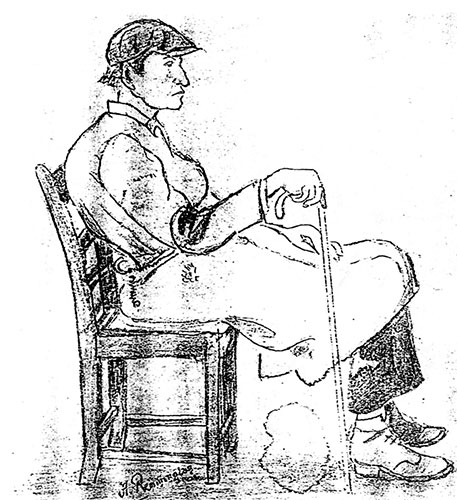 Bob Beale, sexton and gravedigger at Briston church in his sacks, by H. Hemmington The likeness is so good that John Gaskin recognised Bob as soon as he saw the picture, although it is many years since Bob died |
| We had two butchers whose signs both read "Family Butchers", Mr. Joice and Harry Stalham. Both served the community with cuts of meat to suit all purses. Harry Stalham, Billy Dunham
and Harry Pilch would visit Norwich market every Saturday to buy bullocks, which would be transported by train to Melton station and unloaded at the cattle pens. We boys spent many happy hours at the cattle pens watching the bullocks, sheep and pigs being unloaded. Harry could tell the weight and value of a bullock simply by casting an eagle eye over it. I can remember spending a deal of time with Archie Copeman cutting up fat meat and rendering
it down to dripping in a large copper similar to the type used in that day to boil clothes in. Doctor Welsh lived close to the post office ; he was a Scotsman. The picture of the human skeleton and parts of the body hanging in the surgery used to rather scare me as a little lad. Nevertheless, he was a good doctor and attended to our needs. He was inclined to be very quick of movement; up the stairs, down the stairs - into his car before you could say "Flu". On the opposite side of the road to Harry Stalham was the bakery owned by Mr. E. A. Rose and named "Hygienic Bakery". Mr. Rose was a member of the Brethren meeting at Avondale Room. Arthur lived out his Christian beliefs in his business and his life: One day he gave his best coat to a tramp who said he was in need. Arthur's father had come to Melton from Stradbroke, Suffolk, and occupied the bakery, which the company had built in the 1900's. By any modern standards it was "quite a set-up"; hot air, coke-fired ovens, built by Rhodes of Manchester, with white tiled bricks; a drum dough machine, a cake and sponge machine, all of which were turned by hand. The bakery, like the Company's houses and streets, was lit by gas manufactured at the gasworks at the end of Colville Road. Arthur married Miss Rachael Phillips and went to live at Fakenham and my father took over the management; we left the house where I was born in Kitchener Road and went to live at the bakery. The goods which were manufactured were of very high quality and only the best ingredients were used. After leaving school I worked full-time in the bakery (I had worked part-time whilst at school) and can vividly remember cranking that sponge machine until my arms ached and watching the skill with which the flour was blended into the batter by my father. The wholesome, crusty bread was delivered hot from the oven in hand carts. We took orders for the cakes and buns and these were delivered by a lad after school. There was a family in Gordon Road with the name of "Porter", most of the boys in the family did this part-time job during their school-days. Many of the loaves were baked on the oven sole. It was quite an art setting a batch of bread onto the oven sole because once they were set in they could not be moved until they were cooked. "Hot" was the magic word - all the goods were taken to the customers within a short while of them being baked. No "fridges" in those days; everything was oven-fresh. There were many services rendered which would astound people today; for example. hot water was given free (heated in a tank under the oven). Those who had time to spare, and unfortunately there were many at that time who were rendered idle through unemployment, would come to get warm, for a chat and a free bun. Linen was dried in the stoking room and customers would bring their "bakings" to be cooked; 2d for a joint of meat or a chicken, 1½d for a cake, 1d for a tray of short cakes. Christmas was always the busy time; customers would make their cakes and bring them round to be baked. Each would have their own recipe, which meant that the resulting cakes were of great variety: some would come up, some would come up and go down again. Then, when they were called for, the problem arose as to whose cake was whose: "You know mine, Mr. Gaskin; mine are wrapped around with the 'Herald'." (They were nearly all wrapped with a copy of the 'Herald', not many with the 'Times'.) I remember coming home one day from the bread round at about two o'clock; the others had already eaten their lunch, so I dined on my own. I had just finished a fruit pie which I had presumed was my "sweet", when I overheard my father say, "Well Miss Linda, I can assure you it was here a few minutes ago." It suddenly dawned on me that I had eaten Nellie's pie. After that when she sent things to be baked she would say, "Don't eat them Dack !" (She always assumed it was Eric who had eaten the pie.) The Co-op flourished with various departments - groceries, drapery, coal and shoe-repairing. Mr. Bloomfield was manager and Mr. Oliver delivered coal with a Ford 'Model T' lorry. Vic Vardigan was in charge of the boot and shoe repairing department. We boys must have tried Vic's patience as we would make our way there time and time again : "Please Mr. Vardigan, will you put a toe (a hobnail) in my top?" or, "Please Mr. Vardigan, can I have a piece of wax to wax my cockerel?" (A piece of string threaded through the bottom of a cocoa tin.) Vic's hand-sewn boots and shoes were a dream of craftsmanship. He and my father had been at Reepham school together and served their apprenticeships at the same time, Vic at shoe repairing and father at Mr. Overton's the IXL bakery. The wages were 1/- per week for the first year, walking each morning from Petty-Well to be at work by 5 a.m. Even by the standards of the day, these were grim conditions but the rigorous training seems to justify itself in producing good craftsmanship. The fish and chip shop was run by Mr. and Mrs. Simons. In my imagination I can still hear Mr. Simons as he went around with his basket of fish shouting in a fine tenor voice, "Fine kippered herring". A pennyworth of chips was the order of the day for the boys and girls, or perhaps if times were tough - and they often were tough - it had to be a halfpennyworth of "scraps". The fish pans caught fire one night, causing great excitement to the younger members of the population, but the prompt action of one man who threw sand on to the flames soon put an end to the conflagration. Undoubtedly the most colourful and interesting emporium was that of W. O. & George Fisher. It certainly was the forerunner of the modern supermarkets. George was a chemist of renown; educated at Gresham school, his knowledge of medicine and "cures" was quite unique and a single dose of one of his potions had a magic effect in curing a 'flu cold. Mrs. Fisher had a haberdashery department and also took an interest in the Temperance Society. Each time a boy or girl signed a "pledge" they were presented with a bar of chocolate. The trouble was that the pledge was broken many times and then signed again and again and each time it received a bar of chocolate. This became rather a racket, Mrs. Fisher discovered, but she continued the good work just the same. William's stock of goods was unlimited and he specialised in seasonal lines. Christmas was the highlight, with the top department in full swing. In the few days prior to St. Valentine's day the toys were again offered for sale at reduced prices and we found these on the doorstep after an exciting knock at the door. Spring was the time when William specialised in wall-paper and all other items required for spring cleaning. Many of the designs on the wall-paper would be frowned on today, but the mothers of the Melton homes made their four rooms clean and tidy with William's aid. There were also seeds for sowing in the garden in the springtime; ice creams in the summer; always the fruit, sweets, etc., filled the air with an aroma, which still lingers in the memory. Melton was the Mecca for many tradesmen who came from surrounding villages and peddled their wares from door to door or, as in the case of Mr. Pegg from Sheringham, rang a bell. The housewives then came to his barrow to buy fish. It seemed that there was always someone around selling something or trying to persuade people that they ought to take out some insurance or change to some other daily newspaper : "Do you take the News Chronicle ... ? We will offer you (this or that) if you will take it daily." Mr. Holsey from Hindolveston used to come round with oil and buy up rabbit skins. He called all his customers "Mrs. Whas'name". One day one good lady said, "My name is Mrs. X, I will not have you calling me Mrs. Whas'name." - "All right Mrs. Whas'name-I won't call you Mrs. Whas'name any more. Good morning Mrs. Whas'name ... " Mr. Pegg (afore-mentioned) hawked his crabs and fish round the village. He would bring them by train from Sheringham and borrow Mr. Coleman's barrow to carry the boxes of fresh crabs, ringing his bell to announce that he was around - "Open it up for you missus to show you it's full." - 'Real honest-to-goodness' was Pegg, as was his son Kitchener who assisted him at times. Jack Wakefield gave us our first taste of ice cream, in his pony-drawn converted cart. 1d. cornets were a real treat. There were none of the fancy modern varieties; just the one kind -vanilla wafer or cornet and we were more than satisfied. Silky Neale of Sharrington brought us cockles and samphire and Mr. Olly from Edgefield, fruit, fish and vegetables. At least four bakers came into Melton; three from Briston; Bushell, Stroulger and Ives. I can visualise Herbert Stroulger riding in his covered cart down the main street, and on seeing an acquaintance he would raise a ham like hand and say in a stentorian voice, "How do . . How do!" He was a local preacher and on Sundays conducted services in many of the village chapels in the neighbourhood. Herbert used to put the same energy into his services as he did his work. The hymns were read out in a loud voice, hesitating between each number, and the sermon was delivered with such enthusiasm that beads of perspiration would appear on his forehead. Jimmy Strutt (now living at Cranmere House, Fakenham) delivered packet groceries from a hand cart similar to the type we delivered bread from. He would pull this from Briston and it always amazed me how he managed to manoeuvre up and down the paths without falling over linen props and other obstacles. I know he had his little dog to guide him but, considering he was blind, it was still a miracle how he did it. Harry Fisher sold wet fish and Stanley Stone would hawk this around for him on Mr. Coleman's barrow on occasions. One morning my father went to work at 6 a.m. and found Stanley in the bakery (which was rarely locked and if it was, the key was hanging on a nail nearby). On questioning Stanley as to what he meant at that early hour, Stanley said that he had been to Briston to sell fish. "One man seemed a bit annoyed John. I rang my bell and he put his head out of the bedroom window and said 'What do you want?' I said, 'Any fish required?' He slammed the window down John!" At 5 a.m. I should imagine the man was annoyed. Mr. Bangey delivered sleepers sawn into convenient lengths for chopping into firewood. He had a wooden leg; I believe he lost his leg "on the job" - this was before the days of compensation, but I imagine his workmates gave him the privilege of delivering the wood, this being lighter work. We boys always held our breath as he put his good foot on the cart, and away the pony would go and stop of its own accord at the next customer. Characters who came from Briston were Tom Tipple and Trianna, they bought old iron, rabbit skins and anything else that could be sold to make an honest penny. Tom was about 6' 4" tall, Trianna rather shortish. Tom usually wore a mustard and pepper suit. Trianna wore long voluminous skirts with silk Black Top. They never married, the local vicar did persuade them to take upon themselves the privileges of Holy Matrimony but on the day and time of the Ceremony it was only Trianna who turned up at Church ... Tom refused to come so the Wedding never did take place ... Tom came to a sad end ... he was on the roof of his house relaying a tile when a neighbour whom he had fallen out with, shot him with a 12-bore gun ... Tom fell from the roof dead ... Trianna died of a broken heart not long after. Travelling singers and players would perform in the streets, begging for a coin; often these 'buskers' were the aftermath of the 1914-18 war, who on being demobbed found it difficult to get work. One man I recall must have been a brilliant musician. He rarely spoke to anyone, never asked for money, but placed his cap on the ground and his playing was superb. This was my first taste of classical music and the appetite has increased with the vears. When the railway was first pioneered there must have been a marvellous combination of brain and brawn, both types of people working happily together: the thought and the work involved in producing a railway that had so very few accidents; when one considers the fact that a good deal of the line was single-track, it must have been the brain behind the "tablet" system and the men who operated it that made the system run so smoothly. Also one thinks of the thousands of tons of soil that was dug out to form the various cuttings and moved to build up embankments elsewhere and of the bridges, which were built: I went under Melton bridge just before it was demolished and noted the wonderful piece of engineering that it was; concrete girders crossing and re-crossing gave great strength and this bridge never gave any trouble all the years of its existence. Now the bridge is no longer there, in its place is a modern road leading into Melton from Pigs Grave. Driving along this road a few days ago, I had in mind that new industry had been attracted to Melton these past tew years; Astley Terrace is having a face-lift; suggestions and ideas for a brighter Melton are on the board and I sense an atmosphere of hope coming to the village. It is not to be expected that Melton will ever regain its position as the "Crewe of North Norfolk", but maybe like the Phoenix there will be a rising from the ashes and the heart of the village will beat once more. Finally, I would like to send greetings to any old "Meltonian" who happens to read this article. I like to think that the good work that was done in Melton-in the early 1900's - the moral and spiritual work done by the Railway Mission and the Churches, the education in the schools and evening classes, the apprenticeship training, and above all, the art of living together as a community loving our neighbours as ourselves, LIVES ON and is continued by the men and women who were born and bred at Melton and are now scattered all over the world. Norfolk Fair - 1971 |