Melton Constable History

Home

Railway History

Social & Railway Memories

Ralph William Kimber
memories

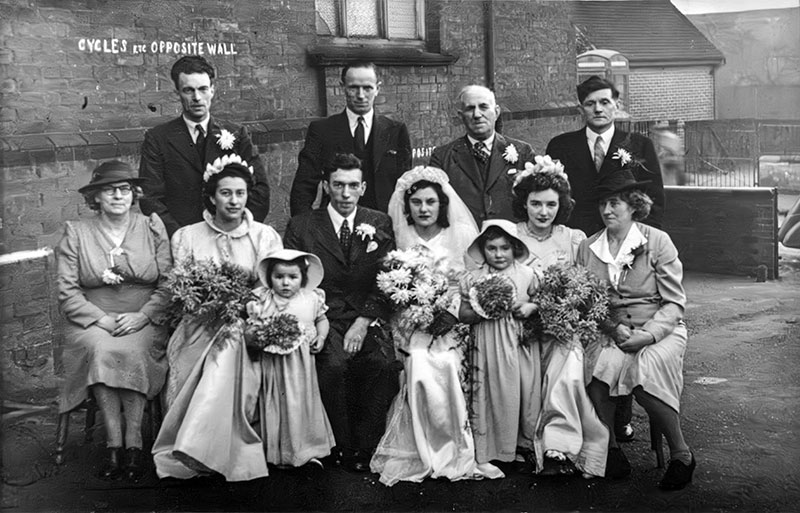
Kimber - Morgan wedding december 1946
Wedding group outside the Railway Institute - groom Ralph William Kimber, bride, Gwendoline Ruth Morgan
December 1946

Railways in the Family by Ralph Kimber - 1989

My memories of railway life go back almost as far as I can recollect. My father, a railway man himself, had railway union papers and railway calendars throughout our home. He was forever telling stories about the railways and I remember that it felt like I ate and slept railways throughout most of my childhood.

Starting at the Bottom
In October 1940, when I was sixteen years old, my dreams came true and I joined the locomotive department at Melton Constable. I knew most of the men and boys that worked there and they helped me a lot, especially in my early days. One of my first memories was of a presentation to Billy English, a retiring engine driver. I felt sad for him, with his railway career finishing and mine just starting - it made quite a contrast.
Upon joining the department I was graded as a cleaner and I was to learn my trade from the bottom up, and I do mean bottom - the bottom of the tender, then the bottom of the engine. Firstly I had to obtain my "tools" and was shewn to the stores where my uncle, William Grint, was a storekeeper. I was given a bent piece of metal called a scaper, a square can filled with paraffin and twelve cloths. Then, off to my first engine. Even now I recall being awestruck by its size, I had never realised just how big an engine was. The engine was number 5329, but later when it became part of the L&NER stock it was renumbered 65329 and classified as a general class puggy engine. Cleaning started with the engine tender which had to have all its grease and dirt scraped off, then be washed down with paraffin and left to dry. having cleaned the tender I was shewn how to do the same to the engine, its wheels, frame and the motions which were the slide valves, pistons, small ends, big ends, scentric straps and the motion sides. I remember getting very dirty as I had yet to learn how to clean without covering myself in all the grease and grime I was supposed to remove. After a period cleaning the bottoms of locomotives I was allowed to do the boiler top which was the dream of the cleaning lads.
(Note - 5329, an ex-GCR J.11 0-6-0 in L&NER stock in 1940 was renumbered 4442 by the L&NER in 1946 later becoming BR 64442)

Passed Cleaner

Several months later I was summoned to the office of Mr Billing, the shed master. The purpose of the summons was to be informed that I had to learn the official facts about locomotives. I was given a rule book and told to learn all 240 rules contained in it and furthermore that I would be tested to ensure that I had learnt them. I spent many hours reading and learning those rules, helped by the engine drivers, firemen and passed cleaners. I soon knew the rules especially those that would affect me. Later a riding inspector from Norwich Thorpe came to test my knowledge of the rules, and having successfully answered his questions I was promoted and became a passed cleaner. This meant I might get a firing turn, if lucky.
A short while after my promotion I was transferred to Norwich Thorpe and it was there that I did my first firing turns. Later I returned to Melton Constable and had a firing turn nearly every day. After a time I became a fireman, but I can still recall some of the men I fired for during this period. Amongst these men were William Dalton, James Greaves, Nobby Rowe, Louis Field, Jimmy Rutland (The Duke), George Cousins, Bert Reynolds, Sam Adams, Arthur Barrett, Edward Green and Fred Bullen. I still love those men - all of them kind and all trying to help you learn your job even though they had had a hard schooling themselves and knew their job backwards.

Personalities at the Locomotive Department
The locomotive department was run by Walter Billing, shed master, Josh English, running foreman (later killed by a German raid on Melton) and Gilbert (Gunboat) Smith. Also Lawrence Massingham, boilersmith, Sid Willmot his assistant, walter Miller, tuber and George Clark his assistant. In the fitting shop were Stan Williamson, Jack Leamon, Walter Scott, Aubrey Watling who were all qualified fitters with their assistants Fred Holmes, Tom Taylor, George Moy and George Clark jnr. the apprentice. The shed staff comprised, in the coaling stage, Joe Horne and Ben Dawson with the shedmen Jack Dawson, Tom Knowles and William English.
Then there were the boiler washers, Reggie Allison, Gus Hutchinson, Albert Grint, and finally the storemen, William Grint and James Howard. All these men saw to the running and making up of the three daily links which were pilot link, middle link goods and reliefs and passenger link.

German Air Raid On Melton

During the war the tragic death of Josh English, running shed foreman, occurred. I remember Josh as a lovely man but very very short sighted. If he shouted for me or any of my fellow cleaners on the late or night shifts we had only to stand perfectly still and Josh would walk past shouting out your name and never realise you were there.
Just prior to the second raid on Melton the main bore engine pumping water for the locomotives and also the town broke down. The old boiler house at the bottom of the railway works beyond the sidings was therefore re-commissioned. Three shifts to cover the water pumping there worked between myself on the midnight to 8.00am shift, Tom Knowles on the 8.00am to 4.00pm shift, and Geoff Allison on the 4.00pm to midnight shift. On that fateful Sunday ....... Josh went to see Tom and then walked up to the main tank that we were maintaining. On his way back to the loco department an air raid commenced. The German planes unloaded their bombs on the old boiler shop area near the water tank. They then machine gunned the area and Josh was shot and killed. Josh English was missed very much and life in the loco department was never quite the same again.

A Prophecy of Doom Fulfilled
I laugh now at the stupid war of words that took place between the ASLEF and NUR in the messroom. I am sure that if the energy and effort wasted in that conflict had been used towards making the railways a better place to work much of the now desolated railway system would never have occurred.
I remember the conflicts between loco crews like Potts Bullen of Melton, Alan Wells and Spot Lemon of South Lynn, Albert Hall of Norwich City, Bill Dalton and many others. Always the arguments ended in laughter and union arguments were always a source of amusement to me.
I can see old William Dalton the NUR secretary, with his goldflake packet in one hand and a cigarette in the other, tapping the cigarette against the packet and telling us that the future of the railway system was that it would become a bed of stinging nettles unless we changed our outlook on life in general. They called him the wise old owl, I guess looking at Melton loco department now, he was.
M&GN Circle


Ralph William Kimber
Born 15 April 1924 - Died 27 March 2007
Born at “Kiama” 13 Gordon Road, Melton Constable.

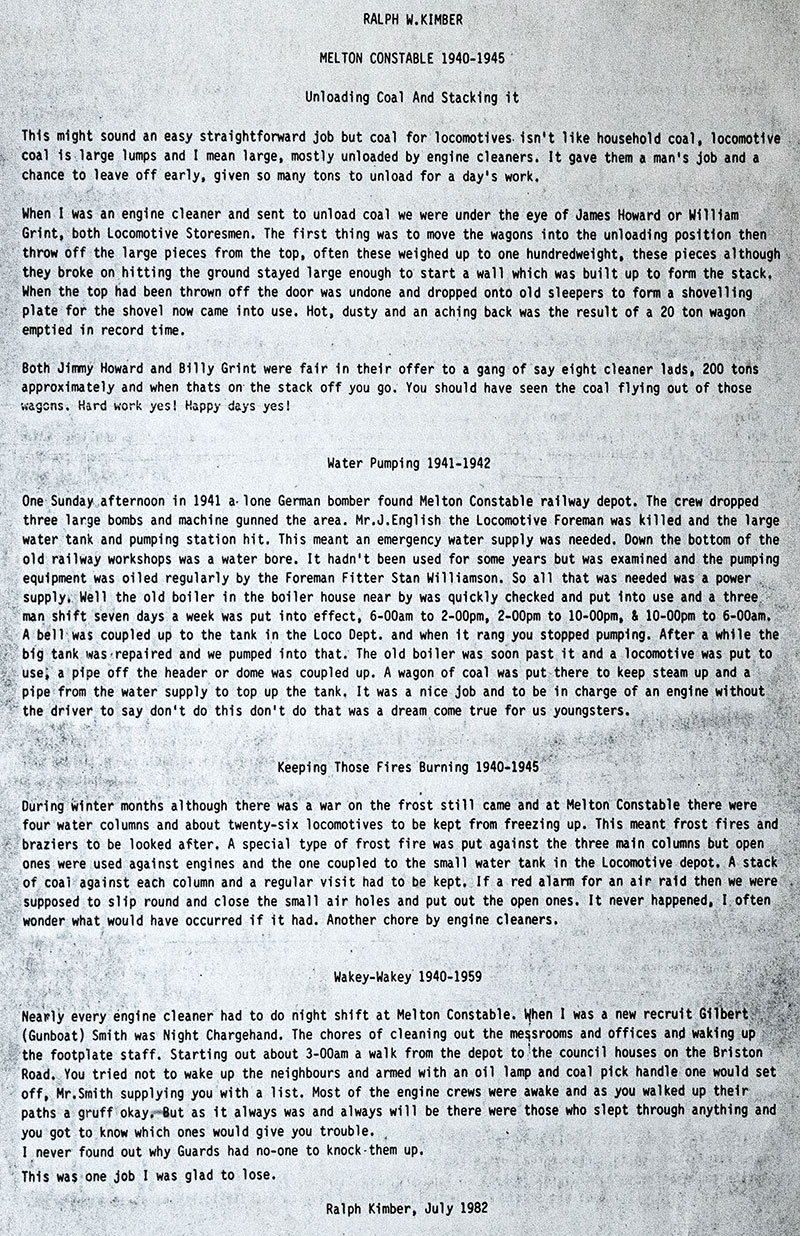
In the early 1980’s, dad decided he wanted to write a book about Melton Constable, so he brought himself several pads of writing paper and made a start. He did not do much, but the following is what he wanted to tell people. It is in own his words and I have made only the odd change so that it makes sense as he wrote how he talked. (His handwriting has been a challenge and some names I’ve had to make a guess at!)
Fay Woods


The Puff Puff’s
Many books have been written about locomotives, bridges, tunnels and viaducts; this book is about the men that built them, used them and loved them. The crews, based on the life in a village in North Norfolk, Melton Constable, referred to as the Crewe of East Anglia, this book then is also about the crews of Norfolk villages around Melton Constable. My first recollection of life in a railway town started in 1930 but I have been able to go to a time before that from records and photos lent me by friends and people, who like me, want to record the happenings of the 1900’s in East Anglia of the Crews of North Norfolk.

Melton Constable, a village in Norfolk, seat of the Lord of Hasting carrier of “her majesty”, spurs set in rural North Norfolk, near nowhere, near nothing, not a beautiful place in any sense of the word but at one time a jewel set in the quiet backwoods of East Anglia. A village of 1886, gaslit, sewage works, tapped cold water these valuable assets labelled the folks as Melton “Swankpots” and this title, if not held now, existed up to the 1960’s.

The life of a nothing village chosen by the bosses of the Midland & Great Northen Railway Committee or as it was known Mid GN Joint or the “Joint” meant no doubt a great change. A village farm, Burgh Parva, with two cottages with Melton Park village had erupted by those Iron Horses that cut the ground into railway cuttings, built big bridges and huge Railway Works, shops, schools and houses, shops where fields and cattle had been, diverted the village stream, tarred roads and all the then modern trappings, gasworks, waterworks etc and this must have been a far greater upheaval than even our New Towns of present day standards.
But these were only at that time peopled by casual men building this then modern town. The new Norfolk folk that were to descend came from all parts of England, Wales and Scotland. I hope in the following chapters to not miss one of them out, many long gone, long forgotten, never quite as you will find as this story unfolds on their life, habits, laughs, sorrows and other things that every community has.

Picture a straight road, a pavement each side, tree lined and at regular intervals more straight roads, yellow bricked houses one side, red bricked the other so was Melton divided Company’s side, Private side, so you told where you lived.
One Public house named as one would expect “Hasting Arms”. Religion, Burgh Parva church of St Mary, Melton Park St Peter, Railway Mission, the Gospel Hall and Avondale House, the regular visit from the Sally Army completes the then religious sect led by Mr Marrott the then known “boss” the builder, designer & engineer of the Joint, liked & hated equally by all who knew him.

As the village town of Melton gained its community life so it shaped its own destiny, its own destruction, for its success in everyone & everything brought a hatred by others not so fortunate as Puff Puffs as we became known: top at cricket, football, tennis, bowls, fishing, snooker & billiards with good faculties to beat everyone who tried to beat us, characters that to this day are still well known & I hope now loved, as good sportsmen given then the will to win which indeed they did, taking on town sides like Norwich, Kings Lynn, Cromer, Yarmouth, Dereham, Swaffham and many more. Names like Long, Worship, Vince, Clarke, Grint, Adams, Barrett, Coleman, Vardigans to name but a few of her top men, still make me feel proud that I too am an old Puff Puff & shared I am sure by many scattered all over United Kingdom and further.

Melton Constable school up to the retirement of Mr E.N Thorne boasted only two headmasters, the first being Boss Hamer. This small school educated some of the finest brains that a village school ever had the chance and later a higher standard school was built just outside the boundary called Melton & Briston Higher Standard, this again had one outstanding headmaster Norman May: one of the greats in education at that time in village life and he set a very high standard of behaviour.

When Grammar education came, children went to Fakenham and of course the better-off folk liked to get their sons into Holts Gresham school. These unlucky children were however like outcasts with the other children and I'm sure many has been the case of boys at least not trying their best in tests held at school (later to become our 11 plus examination).

The village also had a Club envied by all surrounding towns & villages, a large building of no beauty, it housed Mr Marriott's Railway Mission and also a very good Library & Reading room, three billiard rooms, 2 committee rooms. The football, bowls and fishing teams & clubs were run from this club known as the Railway_Institute. The first well-known caretaker was Mr Davidson; he had I think worked for the Lord Hastings, a sombre man but very fair minded, he often turned a blind eye to boyish pranks. He in turn was followed by Robert Wilson, a different man, who is remembered by many as old Bob; he would tell Mr Newman the smallest prank, Mr Newman, GQ as he was known, ran the club as a sideline holding an official position on the Railways & Secretary to the club, a keen sports lover himself, he was also a strong conservative minded man.

Another local man that took active part in politics and was a sports lover was Charles Barrett - his politics being Socialist, but this didn't deter these two to running the club quite successfully. Charlie’s love was fishing but as a P W (Permanent Way) Inspector he is best remembered. Remembering Billiards & Snooker brings names like Bert Smith, Roland Meek, Sid Brooks, Sam Adams who made their mark at those sports and later Stan Vardigans, Tony Coleman, Alan Bullen, Fred Barsted have followed to give a good account of themselves in the now Country Club as the old Institute has been named.

However, great store was set from the Marriott days in Praising God in the Railway Mission, part of the Railway Institute. Their choir was well known in most parts of Norfolk and Mr G.B Clarke dedicated himself to its service ably assisted by his wife. The children's Sunday school run by Johnny Copps & others gave many happy hours to the locals with Sunday school Anniversary Prize Giving & the Sunday School Treat, a trip to Sheringham and there are many tales to be told of these outings, which I will try to fit in later in this book.
The choir ran for many years and only after Mr G.B.Clarke left Melton Constable to live out his life with his children on the south coast area, that the choir ended. Its voices are still heard no doubt by many old Meltonians and then Christmas Carolling around the village streets had to be heard to be appreciated as we lucky ones who have seen them under the Gas lit lamps lights then voices only drowned by a Locomotive whistle or the banging buffers of shunting yard workers.

Its shops starting with the first - a family grocers Mr Colman follow by his son, then grandson as it still is today and I hope continues. Next was a Butcher shop, I first remember Mr & Mrs Harry Stalham but before them I'm told was a Mr Raby, now its Baxters.
Then the favourite Mr Arthur Rose, Confectioner & Baker a real Christian man. There were two barbers, Mr Eke and Mr Cletheroe, next was another character Mr W.O. Fisher Chemist & General Store.
Two Co-operatives, one Drapery & the other Grocery and not forgetting the Co-Op Hall tucked underneath.

Vic Vardigans ran a boot & shoe shop. Jove the butcher followed by a Mr Riches & The Post Office, Molly Linder & Nurse Clarke being its Postmistress. The Fish Shop run by Mr & Mrs Simmonds. Others have followed these names and now strange names to the old Meltonians fill these shops; never again will they be filled like those olden days more is the pity.

There are many stories to be told about these stores and one I must not leave out as summertime came round, we had Mott with his ice-cream sold from his house on Briston Road. Prugpie from Norwich and Jack Wakefield from Hindolveston, who together with a Mr West from Sheringham & Skimp Simmonds, sold fresh fish around the streets of Melton. These then make up the bulk of Melton traders, but we would be wrong to miss out Mr Peck from Lee’s of Holt, thereby being many tales to be told later.

Melton too was surrounded by well tilled allotments and in later chapters, many Norfolk yarns will be unfolded to the readers, just to help any old Meltonians. Claud Roper’s allotment will of course render many of these stories.

Melton too had had the Boys Brigade and a good troop of Scouts led by a Mr Langly and for the girls, Girl Guides & Brownies and a Red Cross section of very high standards. In nearly everything that its people of Melton Constable took on they seemed to have done it to a very high standard none more than Ambulance Competition and only the closure of the Railways caused the cup that so proudly stood for many years in the Station waiting Room to leave Melton forever, and wherever the old Sweedy Section (LNE) British Railway (RE) or whatever they now call themselves have taken this grand cup, it may have its silver medallions removed but it can never ever lose the hand grips that countless hands have placed on it in the many years it was competed for on the old M&GN Railway and I hope the mention of these events stirs someone somewhere to the effort they and their mates put in to win that cup for their respected stations, and fitting some names to its memory I apologise to any one not mentioned but Claud Roper, Bert Willard, Claud Gase, Alf Surpell, Arthur Sleggs, Reg Scotney all had their moments of glory together with many, many more.

Allotments
Melton Constable was unique in the fact it was divided, one side the Railway Company houses, the other were private owned houses; this also led to two lots of allotments - one lot on the private side form a letter E without the middle bar thus fencing in that side of Melton, the other side was a large piece of land hired from Lord Hasting and divided into 20 rod strips. Most of these has some form of hut on them made from old carriages, box wagons or rough built huts that the allotment holders could put their garden tools and store vegetables etc. Many however became like second homes with curtained windows, old settees, chairs, tables and not least cups & kettles for their brew of char (tea) and of course little gangs of mates would sit, especially on wet mornings and many had old guard van stoves which they could take the chill off these huts with, also to boil their kettles if they hadn't any other stoves like primus or oil stoves.

Of course, these huts and congregation of men also provided many wonderful stories weird and far fetching, nevertheless entertaining to many such as myself. Names like Jack Riseborough, Louis Fields, Lolly Massingham, Swats Allison not forgetting of course Hicky Chapman and many others. The tales they told need a book on its own but I'll try and relate some that I remember.
Hicky’s tales were my favourites and Jack Riseborough’s were a close second so to these two I’ll relate some stories.
Hicky had a small holding at the Briningham-Burgh Stubbs road junction and most of his yarns were about this one, I loved this one about his shooting the crows that attacked his barley crop, an old shot gun loaded with tintacks soon took care of them pinning them to the branches of a tree, alas however he over did it, overweighed, the tree crashed down. Another tin tack yarn was about pinning a hare to his five barred gate. Changing his yarns to ducks that he had fattened the biggest ducks bred in Norfolk; however, the weather was hot and so the pit in his wood was empty - poor ducks had never seen water only to drink alas one night a heavy thunder storm filled the pit to the top, the ducks frightened, tried to swim across the pit only to drown because they were too heavy.

Many old Melton people will remember his cricket stories, the best I think being when Melton Park CC played Thornage CC, who needed 3 runs to win, the last man was in, the Thornage man hit the ball high in the air and so hard it split in two, Hicky set off after it catching one half, he chased on catching the second half as the Thornage man crossed for the second run, clapping both pieces together, “How's that” Hicky had won the game for Melton CC.

Jack Riseborough’s tales were every bit as farfetched and one or two I recall. His most known was setting a sunflower seed with a special mixture of compost, it grew so tall and thick round it, his father chopped it down like a tree & used it to repair his house. Another was catching the two biggest pike in the Park Lake, putting them in a box and taking them home to show his mates, alas when his mates looked in the box it was empty, reason, they had been and ate each other.

Of course, most day-to-day happenings of their jobs filled the huts with arguments and critics of certain drawers and shunters etc and when general & local elections took place, the arguments were at their best. However, on these allotments, fine competitors of produce was often of very high standard and quality, not so much to show in Garden Shows but for the local harvest Festivals that each religious body set as a show piece.

Again, the divided village had a total different allotment system. On the private side was much less a meeting place and less was made of huts, more on trees & produce, chickens etc. I must not miss out Mr Claud Ropers allotment for it was here in Mr Ropers’ willow made sheds, these were a carefully woven willow branches until a summer type house resulted, very well made too, and the funny stories he told us youngsters made many happy hearts, also instructions on First aid and his dressing up was another great treat which we pick up again later on.

The Shop-keepers
Melton Constable, was of course a great gain for traders as the railways provided a good supply of customers. Then the village only had one pub, the “Hastings Arms”. This has survived the cruel axis of time that destroyed the railway and the Lord Hastings estate's gone now forever. Most people will only remember Mr and Mrs Prestwood, good landlords and until Mr Presswood's death, so it seemed it would remain. His widow, however, kept it on for a while. Then we were lucky for Billy Dunham and Nora his wife took over and many happy an hour was had for Mrs Stalham lived with them retiring from the butcher shop. So, with the TV Racing at night, a good pint, a hot sausage roll and a Bob each-way we in Melton had, it seemed, at last somewhere other than the Railway Institute to go to. It was too good to last, at alas, Billy and Nora moved out to take another inn at Beccles, where sadly, I hear Nora has died. This then followed a flow of landlords that I am and many others have lost count and names of the landlords.

Mr Cyril Coleman kept a bicycle shop and in the old days charged accumulators (batteries) and cycle repairs, he still trades.
Mr Eke had a Barber shop, which was another meeting place, his two sons, George and Peter, taking over after his death. George doing the ladies hair and Peter the mens. Many local lads will remember this shop, for it was from the windows of this shop everyone coming off the train or going to them was vetted and with the characters like Buster Barsted and Muggins Fuller, many tales could be told and it was ‘not a good place to go’ as quoted by a local Christian gentleman to me.
The only other place in Melton where one could get an alcoholic drink was the refreshment room on the station and in the posh side as it was known. A small group of friends always could be seen having a drink until it closed.
Melton Constable had its own post office and under Mrs Nellie Linder, helped by her companion, Nurse Clarke, they run quite ably, my own brother Fred started there as a boy messenger and is now nearing the end of his working life, still a post office worker. Many names come back with Postman, Cletheroe, Eke, Grimes, Reynolds, and Horn just to name a few who served the district, 
and Nellies cry of Freddy ‘Telegram’ is remembered by many, I'm sure. Now it's just a shop. The post office moving down to the old Co-op shop, now a small supermarket.

In Gordon Road, Joice the butcher, was followed by Tom Riches, then a Mr. A Warnes, now Mr Williamson, over to the famous butchers Harry Stalham, also a small farmer at Pigs Graves at the Briningham, Swanton Road Junction. I'm told a Mr Raby also was involved in this I am not sure. These butchers brought their cattle at local markets as they were brought to Melton Constable pens by train. All the boys would rush to see them unloaded and driven up to the slaughterhouse where now stands R Eke’s Garage.

Mrs Stalham was a good one for the horses and I, like many before me, would sneak a bet, in those days betting shops were illegal. Billy Dunham, who married Nora, (reference Hasting Arms), worked in the shop and names like Archie Copeman, Billy Bullock (Corpusty), Claude Morgan will I'm sure ring a bell now this shop is Baxter’s butchers.

Across the road was Rosie's Hygiene Bakers. Authur Rose was a “Christian” that could be all one needed to say, but so great was his confections, it would be unfair not to give him more pen. It was well known he had once given his coat away to a traveller of the roads and many 10/- Note found its way into the pocket of hard-up fellowmen he met on his way through life. ‘Ralph’, he once told me, ‘Life is the greatest gift God gave us. He only takes it when needed’. His cakes and bread were of the highest standard. His hot air coke fired ovens, built by Rhodes of Manchester, were I'm given to understand, unique. Mr Gaskin, his wife, son Jack and daughter Ruth, all in turn helped run this with names like Muriel Strokum, Ernie Dack and the Porter Brothers, who helped deliver the bread by a 2 wheeled cart which was a typical Melton scene.

The Cooperative Society, a local one, Melton Constable and District Coop Society Limited to give it its full name together with a meeting hall. I have been unable to find out exactly when this first started or by whom. No doubt by some strong-minded local Labour Party folk. The first, I myself can recall was the Bloomfields, who later moved to Northamptonshire. They were followed by Mr Cyril Hammond, and during this period, taken over by the Norwich Co-op, who, I regret to say, neglected it so much, that led to its closure. The old buildings were destroyed by fire in summer 1946 and new ones built on the site during the rebuilding programme. The drapery department on Burgh Beck Road were used to carry on business as usual. These premises were later sold and now make up Vardigan's grocers and fish and chip shops. A small wooden Hut made the next shop provided by the British Legion or some such body to help a Mr William Cletheroe run his hair cutting salon.

Next came Melton Constables most important shop and I say this without joking. WO&HO Fisher, Chemist and General Stores. H.O was without doubt one of the cleverest chemists in the time, his cures were known all over and many railway men from Yarmouth, Norwich and Lynn would vouch for that, his dear wife loved by all who knew her, would give any child sweets and must of cost her husband a small fortune, for she would invite us youngsters to sign as a White Ribbon (a religion) to receive a bar of chocolate or some sweets. W.O William perhaps goes down as our most excellent son, still alive. He lives at Bacton. I'm sure he will not mind me relating him how I and many others saw him. His Ford (car), how many happy times we had giving him a push. He was born before his time. He had supermarkets before the words were used, sales, raffles, gimmicks, you name them, he had them. Homemade fireworks, the lot and a local Sunday school leader, later Home Guard officer, he did it all.
So we have, I think, covered all except the Traders that came into trade in Melton Constable.

The Packmen & other Traders
When earlier, I called Melton Constable a Jewel, I was really referring to the fact that here in a small area of streets and houses with several 100 people, all with a regular wage, money to be spent, money to be had by Packman, and other local village tradesman. I doubt if any other village of its time could boast (if that's the right word) of so many trades’ folk entering one place to obtain a living. Each Packman or trader had his or her particular trend or way, and the list prepared you'll find quite a long one. Many local people may remember them, many have forgotten or never knew them.
Milkmen - Bill Everett. Artie Howard. Hector Lambert. George Jones.
Fish - West (Sheringham). Wakefield. Digby, Godfrey.
Ice cream-  Wakefield. Perouzzi.
Flour, grain, etc.- Mr. Hill. (Corpusty Mill). Mr Peck (Edgefield).
Bakers-  Ives. Slouger. Bushell.
Fruit -  Olney.
Basketwork -  Strutt.
Cotton, Wool, Peddler ware - Grey. Hammond. Holsey
Wood - Bangey.
Coal -  Co-op. Attoe Twiddy. Howard.
Meat - H Williamson. Jones.
Grocer -  Reynolds, Webster, Mr Peck.
Tea, coffee, beer, spirits. Lee (Holt).
Rags and bone - Holsey Whitefield. Tom Tippler and Triana.
Paraffin – Olley.
These some 30 men who found that Melton Constable was a good place to earn a day’s living, I would need a book to devote all of these people their place in this record but this I am unable to do. Therefore, I have only picked out the main characters of these tradesmen and Packmen to make this chapter enjoyable.

I suppose anyone who lived in those days would pick Tom and Triana Tippler out as the pick of the bunch. Tom 6 feet plus Triana 4 feet plus collected rags and bone, rabbit skins, feathers, old iron, junk of any and every kind often very drunk, sometimes Tom was very violent. Tom was shot to death on the roof of his cottage in Briston in 1938 by a neighbour. To take an opposite to Tom Tipple, I've chosen Slogen, the Baker. His voice was loud and full of praise of the Lord. He wasn't to all accounts as good a practising Christian as he liked you to believe. One person who worked for him said, “He works you like the devil”.

One funny aspect of trading in Melton Constable was a great pretence to be a Bible carrier, this gave seal to Mr Marriott and often secured one’s job, thereby hang a tale, which makes me choose Mr Peck, Lees of Holt Packman, he would to us youngsters amusement tuck a flask of gin, whiskey, etc in his side pocket. One, I might add, big enough to hide the dreadful stuff while openly, he carried packets of tea or coffee for all to see. Many leading church and Chapel men and women enjoyed a nip under this guise.

To leave out Mr Strutt, “Blind Strutt” as he was known, would be wrong for this man made a living pulling a small one handed, cart around and with only a small dog to help him. Sold baskets, cottons, silks, etc. And it was marvellous to see him in all weathers slowly pulling his cart, missing the then many trees that were planted on the pavement edges. Going from house to house trying to sell his wares. Many I know bought when they did not really need things.

I'll finish this short chapter with a lady Mrs Grey from Corpusty, warm and friendly a person you couldn't find, her trade of Pots and pan, lids, cottons, silks and umbrellas to mend was a joy to behold. I loved the sound her horse and cart made as it drove along the street. Lids banging and pots jiggling, remains with me to this day.

The Religion
Two churches of England gave Melton Constable a good start to this chapter, St Peters in the park, the church you went to, if you liked a good walk and considered yourself a swanky Christian.
Saint Mary's Burgh Parva if you were a good churchmen, for the hill you descended had to be climbed after the service, and in winter it was a cold walk.

Scouts & Guides
Melton Constable M&GN Scouts was considered to have been the finest in East Anglia. One reason was of course, the Railways ably led by Mr Langley the No 1 to Mr Marriott. Melton's Scouts were able to have many extras that other Scouts troops envied, one feature was a Good Scouts Hut, this was built alongside the Railway sidings, alongside the Railway side allotments built of sleepers, it was creosoted regularly and the equipment inside it was up to date at that time and most local lads joined first the Cubs then promoted by age to the Scout troop.

The Guides were on equal power but not so well off, they had to be satisfied with the old Drill Hall (now Railway Mission). This they shared with the then chapel Gospel Hall and a Miss Tyrell is well remembered as their leader, others can no doubt remember other leaders.

Joint Yarns 1
During the 1947 winter snow-up, the Norwich City, locomotive portion was stuck in a snow drift at Guestwick in the cutting on the Hindolvestion side of Guestwick. Three Locomotives from nearby Melton Motive Power sheds were sent one Sunday with a large gang of PW workers and POWs to dig out the train. It was decided by the Powers that be in charge that the three engines with snowploughs fitted would attempt to move the first cutting full of snow.
An Eastern Daily Press photographer asked one of the drivers the best place he thought for the reporter to stand for a great photograph. Unknown to the reporter, the crews included three of the M&GN Motive Power biggest leg pullers, they quickly advised the poor fellow to stand a few feet from the beginning of the first big drift, resulting in when the snowplough pushed by three full regulated engines hit the drift, the reporter was knocked off his feet and buried by the force of snow drift.

Joint Yarns 2
Peterborough Enginemens' Mess Room – The topic – working over M&GN Joint during 1939-45 wartime blackout. New England drivers' comments “How the hell you suppose to find and stop at Ferry is beyond me”.
Joint driver “It's easy mate, just before you get to Ferry station on the driver's side, there is a black gate, shut off there, the rest is simple”.
Silence!!!!


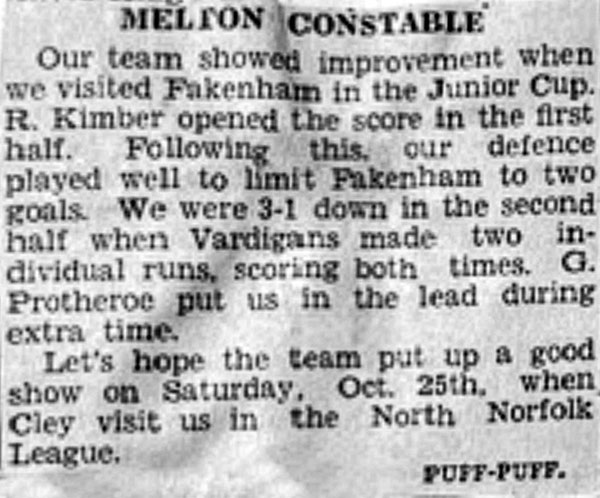
Ralph Kimber football c.1936
Cley were subsequently beaten 1-0 - c.1936

Ralph Kimber memories


If you have any memories, anecdotes or photos please let us know and we may be able to use them to update the site. By all means email or telephone 07836 675369.


Copyright © Jonathan Neville 2025
Top of Page